Explore nautical.im
Lighthousesnautical.im

Home · The lens

The stepped glass

The same 1911 article records that in 1822 Augustin Fresnel constructed a built-up annular lens, with a small central spherical “bull’s eye,” intended at first for revolving lights.⁠1 Later work gave a lens that could also be used in a fixed belt of glass, but the idea is the same: take a bulky lens, cut it into rings, and keep the useful surfaces.

A simplified section of a Fresnel annular lensA geometric meridional section: a small central bull’s eye with stepped rings receding from the axis, and a lamp at the focus. Simplified and not to scale.central bull’s eye, then stepped annular rings
A simplified meridional section of a Fresnel annular lens: a small central bull’s eye, then stepped rings. Drawing: our own, geometric, simplified and not to scale. It is a diagram of the glass, not a picture of a particular lantern.

Lighthouse lenses are still spoken of in “orders.” The order is a traditional size, not a mark out of ten. The optic is listed as a 4th order (250 mm) rotating apparatus. Trinity House records the station as automated and electrified in 1982.⁠2 The optic is listed as a hyper-radial (1330 mm) rotating apparatus. Trinity House records the light as electrified in 1973 and automated in 1992.⁠3 The optic is listed as a 1st order dioptric apparatus. Trinity House records the station as automated in 1988, and names Sir James Douglass as the engineer of the 1875 granite tower.⁠4

Bishop Rock’s hyper-radial optic, at 1330 mm, is a much larger piece of glass than Eddystone’s 250 mm fourth-order lens. Longships is listed as a first-order dioptric apparatus — “dioptric” here meaning the light is bent by glass, in the tradition Fresnel introduced, rather than only thrown by mirrors.
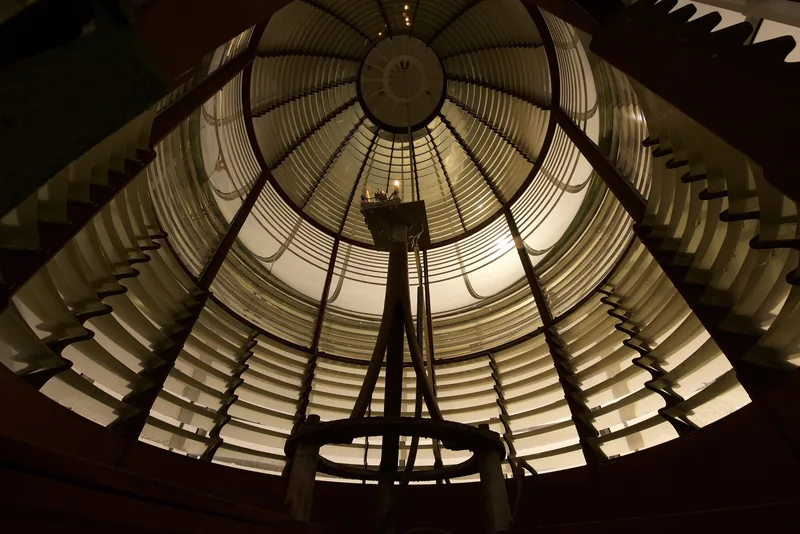
The interior of a large lighthouse lens, with concentric rings of glass rising to a bright centre above a dark metal frame
Looking up into the second-order Fresnel lens of the Tybee Island Lighthouse, Georgia, 25 March 2017. Photograph by Tom Driggers, CC BY 2.0. The lens is at Tybee Island, not at any of the British or Irish stations on this site; it is here as a clear view of the stepped glass itself.Photo: Tom Driggers · CC BY 2.0 · Commons
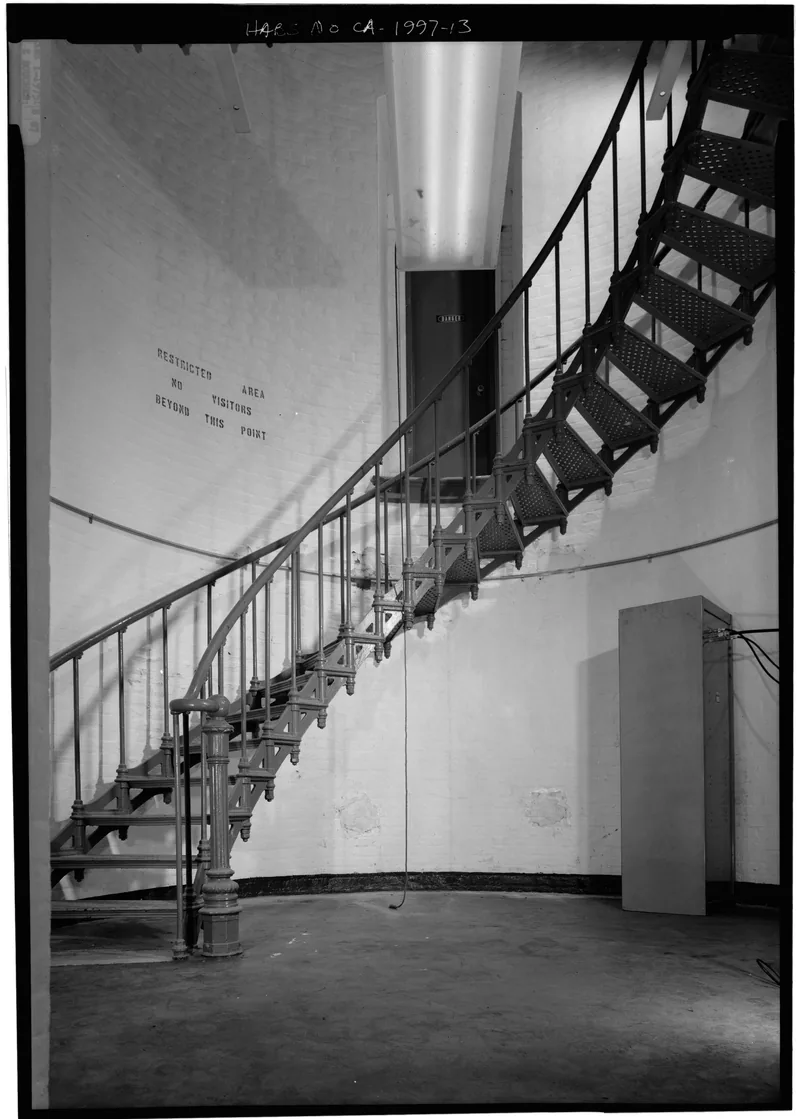
A black-and-white photograph of a cast-iron spiral staircase curving up the white brick interior of a lighthouse, with a restricted-area notice painted on the wall
The spiral stair inside Pigeon Point Lighthouse, San Mateo County, California. A Historic American Buildings Survey photograph, public domain as a work of the U.S. federal government. The 2014 date on the file is a digitisation date, not the date of the exposure. The painted “Restricted area” sign is part of the working interior as surveyed.Photo: Historic American Buildings Survey · Public domain · Commons

A lantern is a room, a stair, and a piece of optical glass. The stair at Pigeon Point is in California, not in the English Channel, and it is here only as a clear view of how a tower is used from the inside.

  1. Encyclopædia Britannica, 11th edition (1911), “Lighthouse” (public domain)
  2. Trinity House, “Eddystone Lighthouse,” retrieved 15 November 2026
  3. Trinity House, “Bishop Rock Lighthouse,” retrieved 15 November 2026
  4. Trinity House, “Longships Lighthouse,” retrieved 15 November 2026